
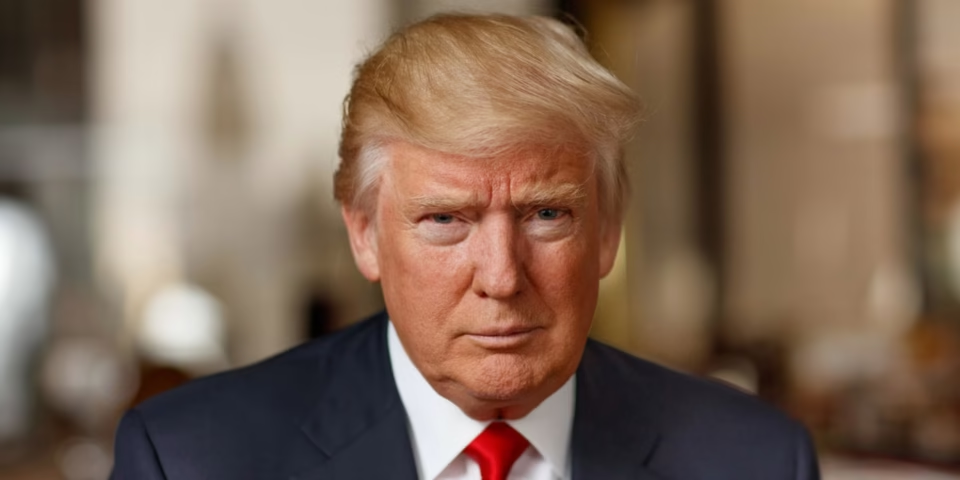
In a fiery statement that reignited debates around U.S. foreign policy and global security, former U.S. President Donald Trump condemned Russia’s latest aerial assault on Ukraine, calling it a “waste of humanity.” The remark came after reports confirmed that Russia had launched its biggest coordinated airstrike since the invasion began in February 2022, targeting multiple Ukrainian cities with missiles and drones. The offensive, which Kyiv described as “brutal and indiscriminate,” resulted in dozens of civilian casualties and widespread infrastructure damage.
Trump’s words carry weight not only because of his continued influence on American politics but also because of the broader implications for international diplomacy. As the war drags into its third year, Trump’s condemnation raises critical questions: How is the U.S. shaping its stance on the Russia-Ukraine war? What does this mean for NATO, Europe, and the global order? And how do such escalations affect ordinary citizens on the ground in Ukraine?
This article explores these dimensions in depth.
Russia’s Biggest Aerial Assault on Ukraine
Scale of the Attack
According to Ukraine’s Air Force, Russia launched over 150 missiles and drones in a coordinated night-time offensive. Cities including Kyiv, Kharkiv, Odesa, Lviv, and Dnipro were hit. Air-raid sirens blared for hours as Ukrainian defense systems intercepted many projectiles, but not all. Critical infrastructure—power stations, railways, residential buildings, and hospitals—suffered heavy damage.
This was not just another strike. Ukrainian officials described it as “the largest aerial attack since the war began.” Military analysts say it reflects Russia’s strategy to break Ukraine’s resilience by overwhelming its air defenses and crippling civilian morale.
Civilian Toll
At least 50 civilians were killed and hundreds injured, while thousands lost access to electricity, heating, and clean water. Social media platforms flooded with harrowing videos of blazing apartment blocks, destroyed vehicles, and families taking shelter in underground metro stations.
President Volodymyr Zelenskyy called the assault “a clear act of terrorism against humanity,” urging Western allies to increase military aid, especially advanced air defense systems.
Trump’s Condemnation: “Waste of Humanity”
Former President Donald Trump, often criticized for his complex stance on Russia during his tenure, used unusually harsh language to describe the attack. Speaking at a rally in Iowa, Trump stated:
“What Russia did in Ukraine is not war—it’s a waste of humanity. Innocent people are dying for nothing. This must end.”
His remarks generated widespread discussion because:
- Tone Shift: Trump has often been accused of being soft on Russia and even praising Vladimir Putin. This statement marked a sharp deviation, positioning him as openly critical of Russian aggression.
- Political Timing: With the U.S. 2024 presidential elections looming, Trump’s words are seen as an attempt to appeal to both Republican voters wary of foreign entanglements and moderates concerned about global instability.
- Humanitarian Angle: By framing the attack as a “waste of humanity,” Trump spotlighted the human cost rather than only military or political dimensions.
Global Reactions
United States
The Biden administration condemned Russia’s actions, calling them “barbaric acts of war.” Secretary of State Antony Blinken reiterated Washington’s commitment to supporting Ukraine with weapons, intelligence, and humanitarian aid.
Trump’s comments sparked mixed reactions within the U.S.:
- Republican Hardliners argued the U.S. should reduce spending on Ukraine, calling Trump’s speech a contradiction.
- Democrats cautiously welcomed the humanitarian tone but questioned whether Trump would follow through on strong action if re-elected.
Europe
European leaders, particularly from Poland, Germany, and the UK, echoed alarm. NATO Secretary-General Jens Stoltenberg emphasized that the alliance would “stand by Ukraine for as long as it takes.”
At the same time, rising energy costs and political fatigue in some EU countries have made public opinion more divided. Trump’s words may resonate with European populations skeptical of prolonged war funding.
Russia
Kremlin spokesperson Dmitry Peskov dismissed Trump’s remarks as “political posturing,” saying they reflect America’s “confused foreign policy.” However, Russian state media highlighted Trump’s history of criticizing NATO spending, subtly suggesting Moscow still views him as less confrontational than Biden.
Humanitarian Consequences in Ukraine
Beyond the politics, the biggest victims remain Ukrainian civilians. The aerial assault destroyed:
- Hospitals and schools, leaving communities without essential services.
- Energy infrastructure, causing blackouts in freezing winter conditions.
- Residential areas, forcing thousands into temporary shelters.
The United Nations warned that the humanitarian crisis is worsening, with millions displaced internally and another wave of refugees expected in neighboring countries like Poland, Romania, and Hungary.
Aid groups on the ground report shortages of medicine, food, and clean water. Children, the elderly, and the disabled are disproportionately affected.
Implications for the Russia-Ukraine War
Ukraine’s Defense Needs
The attack underscores Ukraine’s urgent call for advanced Western weapons, including:
- Patriot and NASAMS air defense systems to counter missile barrages.
- F-16 fighter jets, promised by allies but yet to be delivered in full.
- Artillery and drones, essential for counter-offensives.
Russia’s Strategy
Analysts believe Moscow aims to:
- Exhaust Ukraine’s defenses before winter.
- Pressure Western nations into negotiation fatigue.
- Strengthen its domestic propaganda narrative of strength.
Negotiation Prospects
Trump’s comments may add momentum to discussions about peace negotiations. However, Kyiv insists it will not compromise on territorial integrity, particularly regarding Crimea and eastern Ukraine.
Trump’s Position in the Larger U.S. Political Context
Trump’s harsh criticism of Russia may reshape narratives in the 2024 U.S. elections. Key points:
- Republican Divide: While Trump’s words signal empathy for Ukraine, many GOP members remain focused on reducing foreign aid. This creates an internal party tension.
- Election Strategy: Trump may be trying to broaden his appeal by appearing tough on Russia while also advocating for ending “endless wars.”
- Global Leadership: His remarks could be interpreted as an attempt to project himself as a peace negotiator—a role he has hinted at before by claiming he could “end the war in 24 hours” if re-elected.
International Security and NATO Dynamics
The assault reinforces NATO’s fears of war spillover. Countries bordering Russia, such as Poland and the Baltic states, are reinforcing defenses. NATO exercises in Eastern Europe have been stepped up, signaling preparedness for escalation.
Trump’s past criticisms of NATO spending complicate the picture. While his condemnation of Russia is clear, European allies remain cautious, uncertain of how his policies would play out if he returned to power.
Human Cost: Stories from the Ground
In Kharkiv, 10-year-old Andriy described hiding in a cold basement for hours as explosions shook the city. His mother lost her job after the factory where she worked was destroyed.
In Kyiv, doctors operated on patients in dark hospital corridors using phone flashlights due to power outages. “Every strike feels like the end of the world,” said one nurse.
These stories humanize what Trump meant by a “waste of humanity.” Beyond geopolitics, ordinary lives are shattered daily.
