
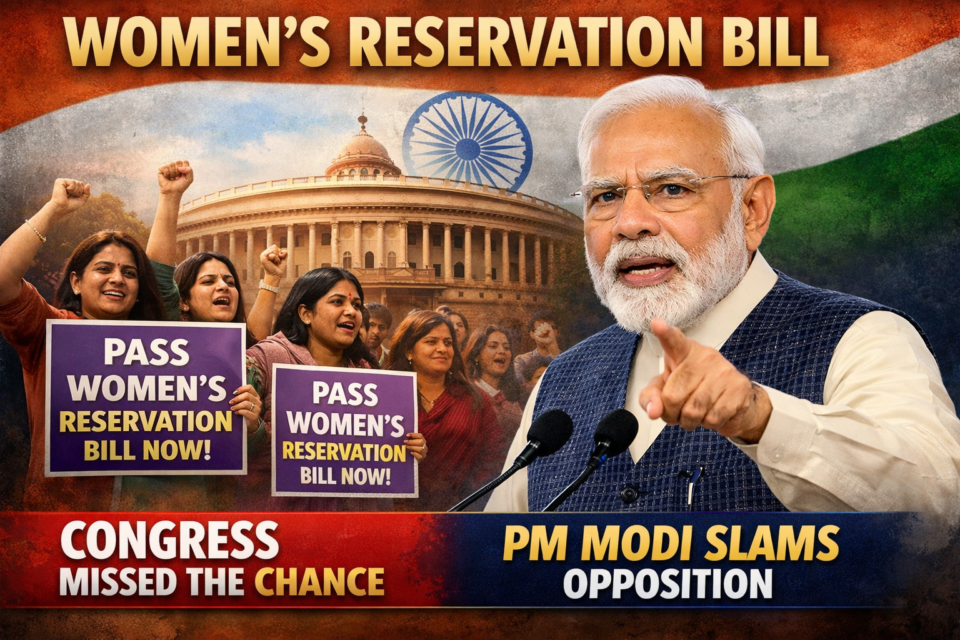
In a significant political development, the proposed Women’s Reservation Bill suffered a major setback after it failed to secure passage in the Lok Sabha, prompting Prime Minister Narendra Modi to address the nation and express regret over the outcome.
Bill Falls Short of Required Majority
The proposed legislation — the Constitution (131st Amendment) Bill, 2026 — aimed to provide 33% reservation for women in Parliament and state assemblies. However, it failed to achieve the mandatory two-thirds majority required for constitutional amendments.
Out of the total votes cast, 298 MPs supported the bill while 230 opposed it, falling short of the required threshold for passage.
The failure also led to the government dropping two related bills, including those linked to delimitation and expansion of Lok Sabha seats, as they were considered interconnected.
PM Modi’s Address to the Nation
Addressing the nation hours after the setback, Prime Minister Modi expressed disappointment and issued an apology to women across the country.
He said that the “dreams of women empowerment have been hurt” despite the government’s efforts and assured that his administration remains committed to ensuring adequate representation for women in politics.
The Prime Minister also sharply criticized opposition parties, accusing them of blocking the bill for political reasons and “missing a historic opportunity” to empower women.
Opposition Hits Back
Opposition parties, including the Indian National Congress, countered the government’s claims, alleging that the bill’s design — particularly its linkage with delimitation — created confusion and mistrust among parties.
They argued that while they support women’s reservation in principle, the government’s approach made consensus difficult.
Why the Bill Failed
Several key factors contributed to the bill’s failure:
- Requirement of a two-thirds majority for constitutional amendments
- Political divisions over delimitation and seat redistribution
- Lack of sufficient cross-party support
- Concerns raised by opposition over implementation strategy
The bill’s defeat marks a rare legislative setback for the current government and has reignited debate over how and when women’s reservation should be implemented in India.
What Happens Next?
Despite the setback, the government has indicated it will explore alternative ways to bring the legislation back.
PM Modi reaffirmed his commitment, stating that efforts to empower women politically will continue and obstacles will be addressed moving forward.
